Flash mobs are the cool new thing.
Advertisers could use this technique to enhance their public relations.
This one was to the Sound of Music.
They can be used in any different way, but more importantly to us, as advertisements. Take this one for example. It could've been used to promote the movie Ghostbusters.
There are many new social media examples, but this one could trump them all if used correctly.
T-Moblie took the charge and put out this mob flash that they tagged their name onto:
Pretty fun stuff.
Now to start planning one for the BYU campus...
Wednesday, November 17, 2010

Tuesday, November 16, 2010
Advertising Ethics
Approximately how many advertisements do you see each day? What would you guess? 20? 50? 100? According to the Media Awareness Network, each and every day, North Americans are exposed to 3000 ads! (http://www.media-awareness.ca/english/parents/marketing/advertising_everywhere.cfm) This includes advertisements that are on shirts, billboards, toothbrushes, and bicycles, just to name a few. We are surrounded by advertisements everywhere we turn. In the room in which I now sit, I can’t count the number of visible advertisements. With all these persuasions around us, we are brought to ask, “Is it ethical?” Does advertising fit the American standard and do those advertisements we see and hear inhibit our ability to choose? In this scholarly research paper, I intend to point out some of the negatives and positives to advertising, and show my audience why advertising is indeed ethical.
Many people consider advertising as a means whereby dishonest people can connive their way into an unsuspecting victim’s head and place little triggers that go off when this victim sees a product or service. These people have an excellent point. Advertising, especially soft sell advertising, is meant to help consumers to have a positive view of a company, also known as the company’s brand. Advertising is persuasive. There is no getting around this fact. Persuasion is probably the main objective of advertising.
Not only is the main objective of advertising to manipulate the viewer’s mind, but oft times the advertisers are wicked people. Most of them do not have standards and therefor, the advertisements take the blame. With such a greedy world, it is hard to find advertisers with morals, so we get ads that contain scantily-clad women, drugs, and inappropriate content. We find problems today that would have been unthinkable 50 years ago. With the debauchery of our society, we see things that not only would be indecent to the LDS population, but also to the general public.
As with every profession, there are people that have low standards, and then those that rise above the scum. The key is to find those people and then help them to become more influential. Advertising is not evil or unethical in itself. There is also much good that comes from advertising, mainly informing people of things they weren’t aware of. How would you know that the iPod was even invented unless you saw a friend using it or an advertisement for it? This is the argument I take sides with.
Let’s take a look at the history of advertising. William M. O’Barr says, “long before America was colonized, commerce flourished in the Old World where various methods were used to promote trade. Notice boards placed outside houses indicated what could be had within. Wine sellers gave free samples in the streets. And actors paraded in the streets attempting to entice onlookers into theatres (http://muse.jhu.edu/journals/asr/v006/6.3unit02.html).” Advertising has been around for many centuries and has played an important role in society. Even our opposition will agree that advertising played an important role long ago. It helped entrepreneurs to show consumers what they had to offer. This helped to establish better communities where free trade could flourish. Free trade is a principle that is associated with Democracies. Communist countries do not enjoy the same privileges that we have here in the United States. Since advertising has contributed to the free trade system, I think it's fair to say that it is partly responsible for the positive government that we have today. We are very blessed to be in a time where we live under such favorable circumstances.
According to the Constitution of the United States, anyone living inside the country has unalienable rights. One of these inevitable rights is freedom of press. In the first amendment, we read “congress shall make no law respecting an establishment of religion, or prohibiting the free exercise thereof; or abridging the freedom of speech, or of the press; or the right of the people peaceably to assemble, and to petition the Government for a redress of grievances.” Contained within that law, we see that we have the ability to print and say what we please. Especially in the case of advertising (assuming situations slander or libel is not being used), this right is just that- a right. We are entitled by law to advertise as we would like to. Having established that fact, we still are left to the question, “is it ethical?”
Mike Catherall of American Chronicle says, “On one hand you have an industry bent on persuading consumers to buy things they don't need by prying into their insecurities, reinforcing oppressive stereotypes and pouring gasoline on the fires of capitalism. On the other, you have an industry with a sudden new desire to make the world a better place.
Where these values intersect is the latest boom in the advertising world: ethical advertising. Targeted at Conscious Consumers, ethical advertising taps into the residual idealism and guilt of activists at heart, and Boomers who have rediscovered their romantic 60s values lost or replaced temporarily by vapid consumerism, only to see the light again in their twilight years” (http://www.americanchronicle.com/articles/view/10795). Opportunity for growth and improvement in the advertising world has presented itself. There are chances for things to become as they once had been through wholesome advertising. Companies are taking these opportunities. For example, take Dove. Dove is a company that has made beauty products since 1979 and continues to influence people everywhere. They are owned by Unilever and they have some positive advertising techniques. One of their most recent is the campaign “Evolution”, which has won two awards at the Cannes Lions International Advertising Festival, and continues to influence women and girls around the world (www.dove.com). The campaign is meant to show females that they are beautiful no matter what they may look like. It has helped to build confidence in young women and has also gone against the grain as far as advertising goes. Ads with morals like this are becoming more prevalent as time goes on. Hopefully, we can continue to see an increase in these uplifting ads. One of the ironic things about the Evolution campaign is that Dove makes products that help to beautify women. The advertisement definitely reflects a positive light on Dove and it's brand. This is a prime example of a soft sell campaign. The objective here is not to sell lotion to people right away after they see this commercial. It is meant to shed positive publicity on Dove. Some would even argue that the campaign was a public relations project, and there is a lot to be said for that. Maybe the day has come where advertising is starting to shift into public relations.
One of the main reasons I believe that advertising is ethical is because the Church of Jesus Christ of Latter-Day Saints uses it.
In August 2008, the LDS Church launched a campaign called “Mormon Messages”. These short films were designed to share prophets' and apostles' stories with visual representation. Over time, many have been made and the total viewership has reached over 10 million views (http://beta-newsroom.lds.org/article/mormon-messages-on-youtube-reaching-millions)! Currently, there are an assortment of different topics that you can watch and enjoy. This is a form of advertising for the Church. Missionary work could also be classified as advertising. Without that initial exposure, we wouldn't have the truth and light that we do. The LDS Church is a prime example of an organization that has used advertising to bless the lives of others. Advertising isn't unethical; it's a form of communication. It has helped to bring the gospel to many converts' lives and continues to affect the Church positively.
There are things that can be improved on in the advertising world, but overall, the industry is improving as a whole. The principle of advertising is ethical, although some of it's representatives are not. We see examples all over the world of good advertisements that redeem the industry. Examples like Dove's Evolution and the Latter-Day Saint's Mormon Messages are becoming more predominant as time goes on, and hope is coming back to the American public. The demise of the society has not completely consumed our American living yet and with the addition of strapping young lads like myself, the advertising realm will continue to brighten. Advertising is meant to inform, giving us knowledge and a greater understanding. Usually, the products that advertise well are the ones that perform well, so we have little need to fear being coerced into buying something that wouldn't help us. The product will sell itself. Advertising just helps to make it known. With the 3000 advertisements we see each day, we are merely picking up 3000 more bits of information.
Works Cited Page
Advertising: It's Everywhere. November 14, 2010. http://www.media-awareness.ca/english/parents/marketing/advertising_everywhere.cfm
Dove Evolution, November 16, 2010, www.dove.com
Ethical Advertising at a Glance, American Chronicle, November 15, 2010, http://www.americanchronicle.com/articles/view/10795
Mormon Messages on Youtube Reaching Millions, November 16, 2010, http://beta-newsroom.lds.org/article/mormon-messages-on-youtube-reaching-millions
O'Barr, William. A Brief History of Advertising in America. November 15, 2010. http://muse.jhu.edu/journals/asr/v006/6.3unit02.html
Wednesday, October 20, 2010
Mac Attack!
Is this a common sight for many of you? Have you been around the BYU campus and seen the influence Apple has established on campus? Here, in the library, I took a picture of a regular day. Out of the 12 computers I can see in this picture, 8 of them are Macs! 67%!

I have always loved the uprising of Apple. It has always intrigued me after watching a movie called Silicon Valley in high school. After watching the movie, which depicted the former partnership of Steve Jobs and Bill Gates, I felt a loyalty to Apple that I never had before.
Apple continues to produce moving advertisements, like this campaign:
Apple is continuing to gain market share. I am excited for the day when they will surpass Windows in sales. In 2006, Apple owned about 4.6 % of the market share for laptops overall. Not very impressive, but it has been steadily growing. In 2007, it grew to 5% and in 2008, it kept growing to 5.6%, and Apple continues to grow!
Go Apple!!!
Thursday, October 14, 2010
Climbing a Rock?
Why do people feel the urge to climb things?
Especially in the case of climbing rocks and mountains, why do people do it?
I've decided to use this as a research project for my writing class this semester.
To give you my opinion, here are some pictures I took yesterday from a 600 foot climb my buddy and I did.

Simply beautiful.


Especially in the case of climbing rocks and mountains, why do people do it?
I've decided to use this as a research project for my writing class this semester.
To give you my opinion, here are some pictures I took yesterday from a 600 foot climb my buddy and I did.

Simply beautiful.

You look cool.

And you're safe... for the most part. ;)
Those are a few of my reasons for climbing, but I'm interested to see what others' reasons for it are.
Wednesday, October 6, 2010
"The Devil Can't Make You Do It" by President Boyd K. Packer
"The Devil Can't Make You Do It"
President Packer
General Conference October 2010
Bold as he was in the October General Conference, Boyd K. Packer made some enemies. In the morning session of General Conference on October 3, 2010, President Boyd K. Packer talked about the sanctity of the family and bravely presented his feelings on the Family Proclamation and the sins of homosexuality and pornography. He answered my questions and although no new doctrine was presented, his message brought about a protest on Tuesday because of how straight forward and logical he was, not beating around the bush.
The night before, I found myself asking my date why she thought we, as a church, were so against the gays having an opportunity to get married. It was a question that had bothered me, because I felt it went against the LDS philosophy of agency. Luckily, the Lord knew that this concern would be on my mind and had President Packer give a talk on it the next day (I love how that works). President Packer gave me the answer I had known all along, but never connected. From the Family Proclamation, he quoted “marriage between a man and a woman is ordained of God and that the family is central to the Creator’s plan for the eternal destiny of His children.” Wow, it's so simple. Marriage is something that only applies to a man and a woman, not a man and a man or a woman and a woman. Your agency allows you to be gay together, but don't call it marriage. It's not marriage. Marriage is ordained of God and perpetuates life and the family.
Apparently, the gay community along with a few disgruntled members of the Church weren't spiritually ready to hear this message. On Tuesday, a group protested against President Packer's conference address. It's funny, President Packer addressed people like this in his talk. He implied that you wouldn't vote on absolute truths, asking “what would a vote against gravity do?” His clever remarks helped me to realize that God's truth can't be altered or voted on.
President Packer couldn't have been more bold in his remarks. He used a great sense of logos to present his message in a way that answered my questions, and I'm sure others' as well. His speech couldn't be taken any other way than the way he intended it to be. Great talk, President Packer.
Puffery
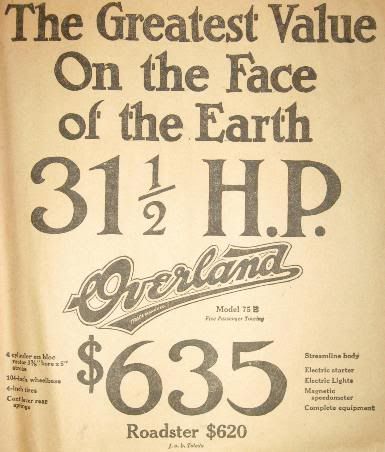
Puffery is a technique commonly used in the advertising world. It refers to an over-exaggeration of a product or service. Examples of this would include saying such phrases as "the best", "the most satisfying", or "the greatest". These phrases don't even necessarily need to be true. They could have the worst, least satisfying product out there. The way that advertisers can get away with phrases like this has to do with proof. There is no calculation that can tell me if your product is "the best." Although the company can't prove that it's the best, you can't prove it's not. Best in what? Even though quantitative claims can be proven wrong, qualitative ones can't. Puffery is present in many companies.
 This probably isn't the greatest value in the world, but you can't prove its not.
Even modern advertisements that you'd never guess, use puffery. Take, for example, Kellogg's Frosted Flakes. They're what?? They're gr-r-reat!! Really?

Look at the ads you see today and notice how many of them use puffery.
Even modern advertisements that you'd never guess, use puffery. Take, for example, Kellogg's Frosted Flakes. They're what?? They're gr-r-reat!! Really?

Look at the ads you see today and notice how many of them use puffery.
Monday, October 4, 2010
My Bold Move
I've been on a few dates since being home, but none were initiated quite like this one.
Friday rolled around and I found myself sitting on a bench outside the Wilkinson Center. A girl came and sat down on the bench next to mine and I heard my thoughts say, "wow, she's really cute." I couldn't keep from looking at her and I knew it was a problem, so I decided I was going to do something about it. You only live a mortal life once, right? So about half an hour went by and I didn't act. I kept waiting for her to approach me (like that ever happens) and nothing came of it. Finally, as class was about to start, I decided it was now or never. Music influences our irrational decisions and I think I was listening to Muse, so I was pumped.
I went up and introduced myself, nervous at the thought of what was to follow. She told me her name was Laura and I said something to the effect of "Well, I think you're really cute and I was wondering if you wanted to go on a date with me some time." Warning signs started shooting off in my brain as she paused, smiling. I had to blurt out "I would never do this, but something told me to." She accepted and gave me her number, telling me she normally wouldn't say yes, which made me feel a little better and boosted my confidence back up a little bit.
We went on a date Saturday night, which was a lot of fun. She came to my apartment to pick me up (lame, I know) and when I opened the door, I was surprised by how beautiful she was [with these situations, you never know if you're just feeling that way in the moment]. We went to the malt shop and then to Comedy Sportz (which was pretty hilarious). She seems really nice and interesting. From California, and has two older sisters. Parents are converts, which is really cool. Overall, it was a great date. There will be a second.
Friday rolled around and I found myself sitting on a bench outside the Wilkinson Center. A girl came and sat down on the bench next to mine and I heard my thoughts say, "wow, she's really cute." I couldn't keep from looking at her and I knew it was a problem, so I decided I was going to do something about it. You only live a mortal life once, right? So about half an hour went by and I didn't act. I kept waiting for her to approach me (like that ever happens) and nothing came of it. Finally, as class was about to start, I decided it was now or never. Music influences our irrational decisions and I think I was listening to Muse, so I was pumped.
I went up and introduced myself, nervous at the thought of what was to follow. She told me her name was Laura and I said something to the effect of "Well, I think you're really cute and I was wondering if you wanted to go on a date with me some time." Warning signs started shooting off in my brain as she paused, smiling. I had to blurt out "I would never do this, but something told me to." She accepted and gave me her number, telling me she normally wouldn't say yes, which made me feel a little better and boosted my confidence back up a little bit.
We went on a date Saturday night, which was a lot of fun. She came to my apartment to pick me up (lame, I know) and when I opened the door, I was surprised by how beautiful she was [with these situations, you never know if you're just feeling that way in the moment]. We went to the malt shop and then to Comedy Sportz (which was pretty hilarious). She seems really nice and interesting. From California, and has two older sisters. Parents are converts, which is really cool. Overall, it was a great date. There will be a second.
Subscribe to:
Posts (Atom)